Work / STARS / Software · Visuals
STARS Dome
Open
- RendersDomemaster films and stills.Watch · soon
- DesktopLinux, NVIDIA GPU (CUDA). Distribution is being prepared.Download · soon
About
Made for the dome
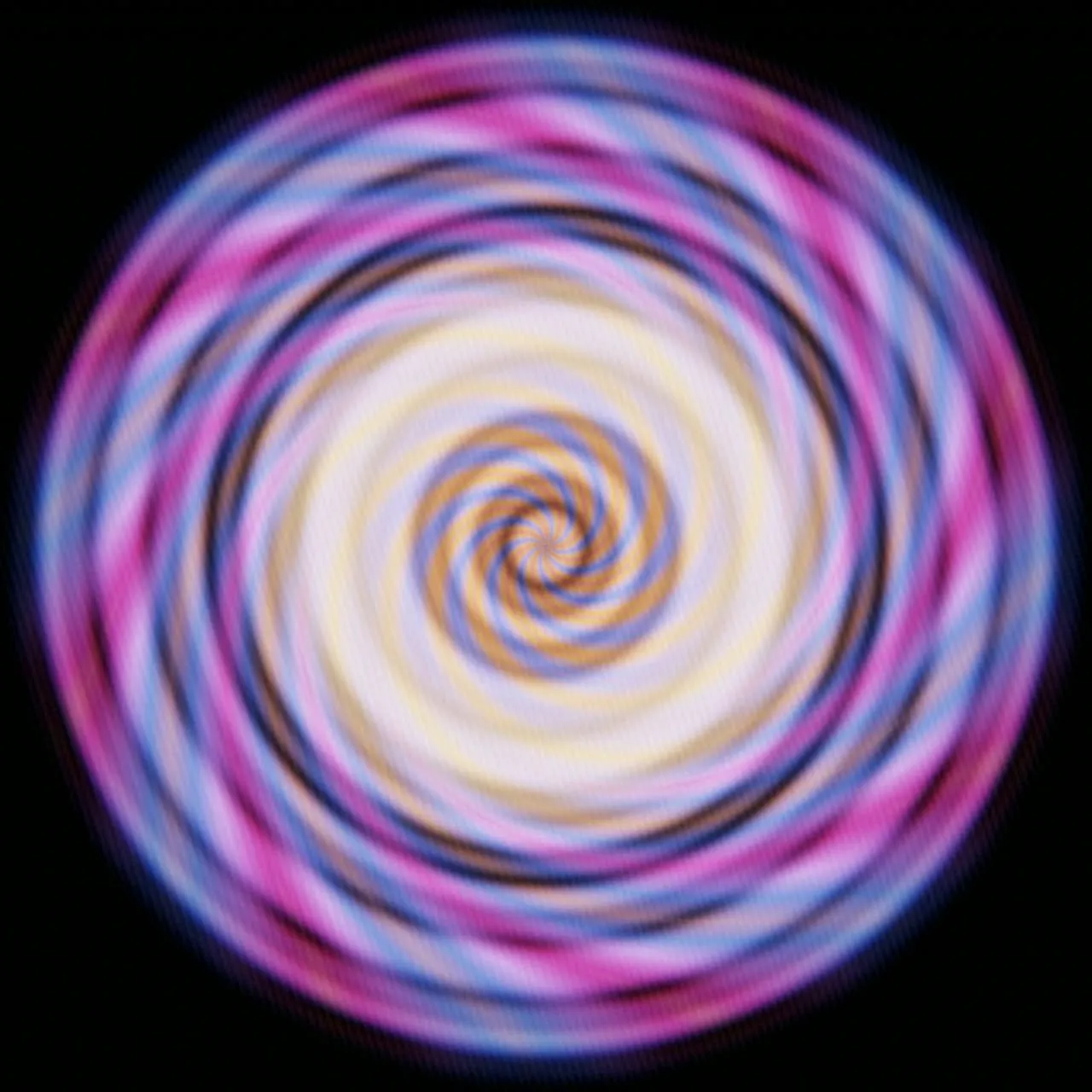
A planetarium dome wraps the audience: the image is a circle inscribed in a square, and its centre is straight overhead. STARS renders directly in that projection, at 4096 pixels square, and its production guide records what works there and what does not. Slow camera motion, because fast motion makes people sick; the zenith as a focal point; radial patterns that use the circle; volumetric depth that puts the audience inside the cloud. And what to avoid: fast sideways motion, thin horizontal lines (they become arcs), pure black (the dome’s panels show noise in it), and heavy chromatic aberration across 180°.
How it works
Scenes are JSON files: an ordered list of layers, each with its parameters and keyframe tracks. Every layer is a CUDA kernel writing into a shared HDR framebuffer; the noise functions (Perlin, fBm, domain warping, ridged) are device functions every layer can call. After the stack come bloom, the cinematic pass, colour grading and an ACES tone map. The same scene renders in the live preview and headless to an MP4.
Features
- 01
A layer stack on the GPU
Each layer launches its own CUDA kernel into a shared floating-point framebuffer and blends into it (additive, over, screen, multiply).
- 02
Volumes
Ray-marched gas clouds and emission nebulae with three species of gas and self-shadowing, dust that absorbs what is behind it, volumetric caustics, a solar surface with prominences and corona.
- 03
Fractals and growth
Nine fractal types with PBR shading, orbit-trap colouring and hybrids that blend two fractals; crystal growth, L-system trees, reaction-diffusion in a 3D grid.
- 04
Stars and space
Procedural starfields with blackbody colour, the real Yale Bright Star Catalogue with diffraction spikes, hyperspace streaks, strange attractors.
- 05
For the dome
Pulses and sweeps across the dome, kaleidoscopes, elastic grids, synced to a tempo. The projection is a 180° equidistant fisheye, the circle inscribed in the square.
- 06
Post and colour
Bloom; vignette, chromatic aberration, film grain and god rays; lift, gamma and gain; ACES filmic tone mapping.
- 07
Camera and animation
Keyframe tracks with Catmull-Rom and eased interpolation, quaternion rotation, a look-at target that can itself move.
- 08
Preview and production
A real-time preview with an ImGui interface for building scenes, and a headless mode that renders a scene file to video with hardware encoding.
Journal
Media
-
Greg Foat — Interstellar Fantasy, the teaser Contre-Temps festival, Planetarium of Strasbourg (video by Contre-Temps) — project
Live
- Greg Foat — Interstellar Fantasy Planétarium du Jardin des sciences, Strasbourg SVDK · 360° visuals
Credits
- Code, scenes — SVDK