Work / Game
The Chorus Mandate
A top-down space game of trade, war and survival. One pilot, nine powers, a swarm that hunts the lonely, and an economy that runs whether or not you are looking at it.
2026 · in progress
Launch
- BrowserPlay in the browser. Keyboard and mouse, or touch on a phone.Play · soon
- DesktopA standalone build (Electron). Linux first.Download · soon
Briefing
Lethe
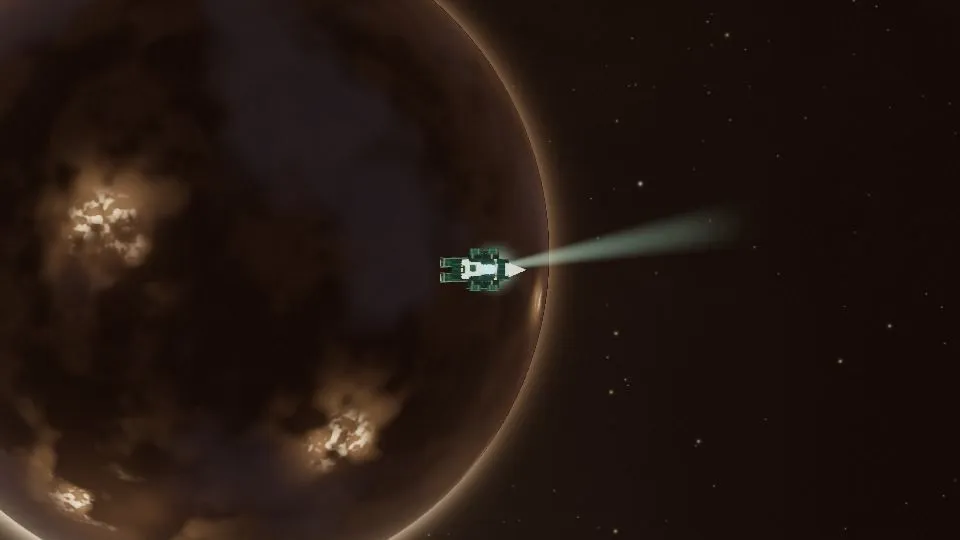
Lethe has no sun. It is a rogue planet on a long pass, and its people live in a ring of stations warmed by vents. The vents are failing, one station at a time. Every dark station still has people in it. You fly for Vent Four.
The campaign is told in three acts, each named by the question it asks:
- Who do we save? Bring home whom you can from the stations going dark.
- Is there a way out? An old levy dish in high orbit might reach past the dark, and someone might answer.
- Who goes? The Levy Gate opens once more before Lethe drifts out of reach. Nothing on Lethe can carry everyone, so you build something that can: an ark, plated, driven and crewed. Then you choose who gets aboard, and cross the Drift with them.
The sector
Outside the campaign, the game is a living sector. Nine powers hold ground, and each one is an answer to a single question: what do you do about needing other people? Meridian Concord’s answer is “Dependency is the peace: be the room everyone has to walk through.” The Crimson Raiders’ is “Take.” Work for one power and its enemies hear about it. Wars start, run and end without you.
You can trade, haul under contract, mine, fight for pay, explore, salvage, pull somebody out, build stations and turrets, run a fleet, follow the story lines, or take a side and fly under a power’s colours.
Under the hood
The game runs on engine-v3, a genre-agnostic engine written alongside it: an entity-component system, a fixed-step loop with interpolation, a Three.js renderer with its own post chain and film grain, simulation level of detail, and positional audio with music chosen by place. The space game is one consumer of it.
The manual is written from the code rather than from memory: every number in it is a constant in the source, and the file it lives in is named.
What is in it
- 01
The campaign
Foster-Child of Silence: a story on the rogue world Lethe, in three acts, with a cast, briefings, interludes and a timeline that fills in as you play.
- 02
Free play
A living sector of powers that trade, build, go to war and answer the Chorus, with you as one pilot among them. Every run grows a different sector.
- 03
Runs
The Crossing, Last Light, Silent Running, Convoy, Salvage Rush, Duel, Death Rally, Naval Battle, and Front Line, a real-time strategy prototype.
- 04
Flight and combat
Power pips, weapon groups, auto turrets, subsystems you can shoot off, rear and flank hits, shields with character, decoys, blink coils, quantum jumps.
- 05
Fleet
Ships of your own on the wing or detached to trade, picket, mine or supply. A command mode with orders and formations, and a wing that talks and earns.
- 06
Economy
Mining with heat and seams, markets that move, contracts, holdings, haulers on your own routes, yards whose prices answer your standing and their stock.
- 07
The Chorus
A swarm with synapses, spires and creep, and a brood that hunts the lonely. Its tissue can be researched and grown into your ship. It eats.
- 08
Presentation
Hull plates and outlines everywhere, a codex, a sound board for replacing any sound, music by place, loading tips, phone controls.
- 09
Multiplayer
A shared sector on a dedicated host, separate purses, PvP by allegiance. In progress.
Dev log
- 12 Oct 2026 Alpha 26: a home you build→
Vent Four becomes a place you grow, with people who live there and raids that come for it.
- 11 Oct 2026 Alpha 25: a wing that earns its keep→
Veterans earn modules, your ship fights while you give orders, and Death Rally's rivals finally race.
- 10 Oct 2026 A teaser, filmed in the game's own engine→
Alpha 23 builds a film out of the game itself, with the lore's own documents and the writing systems of another project.
- 6 Oct 2026 SpaceShift becomes The Chorus Mandate→
The game has a name. Alpha 15 renames it wherever a player reads it, and alpha 16 makes the first standalone desktop build.
- 5 Oct 2026 Front Line: a strategy game inside the game→
Alpha 13 adds a real-time strategy prototype. Two yards, ore between them, the Chorus on the flanks.
Credits
- Design, code, writing — SVDK
- Engine — engine-v3 (TypeScript, Three.js)